Shocking Truth: AI Automation Is Replacing Jobs Faster Than You Think!
Artificial intelligence is advancing at a speed that is reshaping industries, workplaces, and career paths across the globe.
Many people are only just beginning to realize the scale of its impact. From factories and offices to creative fields and customer service roles, AI automation is gradually taking over tasks that were once done entirely by humans. This rapid shift is raising important questions about the future of employment, the skills needed to stay relevant, and how societies will adapt to a world where machines play an increasingly central role in daily work. See and follow the complete information only at AI Human Agents Business.
The Rapid Rise of AI Automation in the Workplace
Artificial intelligence has developed quickly over the past decade and is now being integrated into many workplaces around the world. Companies are using automated systems to handle tasks that once required human effort, such as data entry, customer support, scheduling, and even parts of decision making. This shift is not limited to large corporations, as small businesses are also adopting AI tools to improve efficiency and reduce costs.
One of the main reasons AI automation is growing so fast is because of its ability to process large amounts of information in a short time. Machines can analyze patterns, detect errors, and generate solutions faster than traditional manual methods. This speed gives companies a competitive advantage, encouraging even more businesses to adopt automation technologies.
At the same time, the adoption of AI is changing expectations in the workplace. Employers are beginning to prioritize employees who can work alongside digital systems rather than rely only on traditional skills. This shift is gradually transforming the structure of many industries and redefining what it means to be productive.
How AI Is Changing Traditional Jobs Across Industries
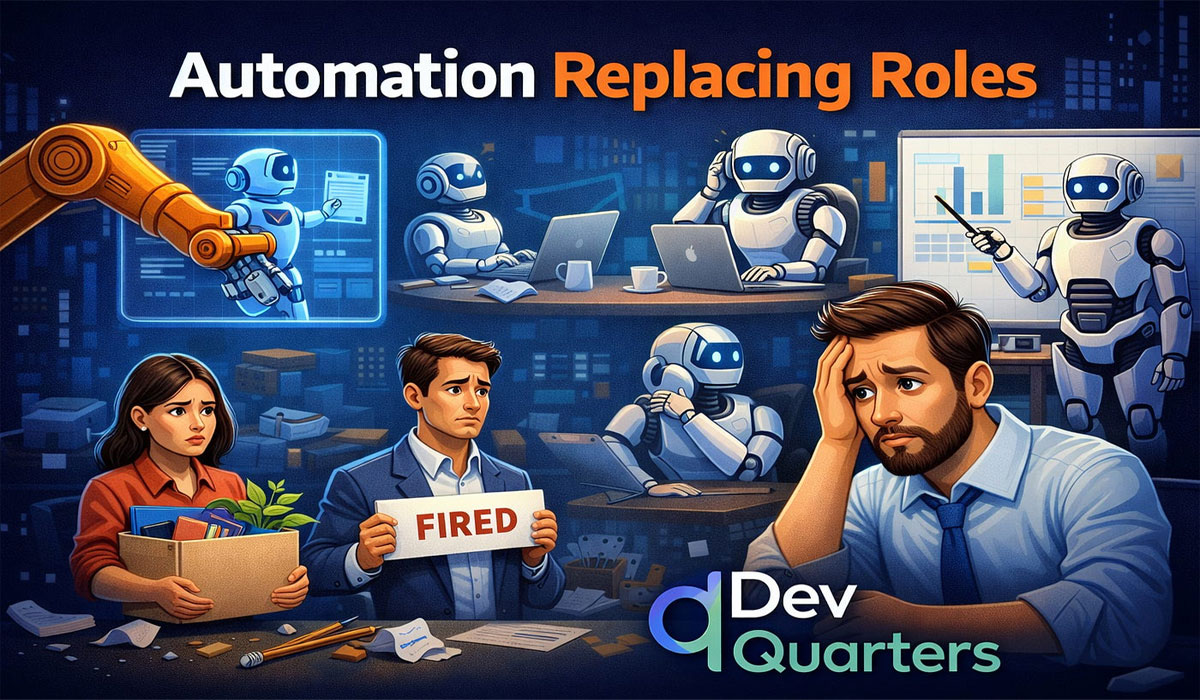
Many industries are already experiencing noticeable changes due to automation. In manufacturing, robots are now performing repetitive tasks with high accuracy, reducing the need for manual labor in certain roles. In retail, automated checkout systems and inventory management tools are minimizing the need for large numbers of staff.
The impact is also visible in office based jobs. Administrative roles that involve organizing data, managing emails, or preparing reports are increasingly supported by intelligent software. While this improves efficiency, it also reduces the number of positions required for these tasks, leading to shifts in employment patterns.
Even creative fields are not completely untouched. AI tools are now capable of generating written content, designing visuals, and producing basic marketing materials. Although human creativity remains essential, the presence of these tools is changing how creative professionals approach their work and how companies allocate resources.
Also Read: Global Alert! AI Tools Are Transforming Lives In Ways Nobody Predicted
The New Skills Workers Need to Stay Competitive
As automation becomes more common, workers are being encouraged to develop new skills that align with the changing job market. Technical knowledge related to digital tools, data analysis, and AI systems is becoming increasingly valuable. Individuals who understand how to use these technologies are often more competitive in the workforce.
However, technical skills are not the only important factor. Soft skills such as communication, adaptability, and problem solving are also becoming more important. These are areas where humans still have an advantage over machines, especially in roles that require emotional understanding and complex decision making.
Continuous learning is now essential for career growth. Workers who regularly update their skills and stay informed about technological trends are better prepared to adapt to changes. This mindset helps individuals remain relevant even as industries continue to evolve rapidly.
Opportunities Created by the AI Driven Economy
While AI automation is often associated with job displacement, it also creates new opportunities in emerging fields. Many companies are now hiring specialists in artificial intelligence, machine learning, cybersecurity, and data science. These roles did not exist at scale in previous decades but are now in high demand.
In addition to new job categories, AI is also enabling entrepreneurship. Individuals can now use automated tools to start online businesses, manage marketing campaigns, and analyze customer behavior with minimal resources. This lowers the barrier to entry for many aspiring business owners.
Furthermore, AI is improving productivity across various sectors, which can lead to economic growth. When companies operate more efficiently, they can expand their services and create new roles that did not previously exist. This shows that while some jobs may change or disappear, others are likely to emerge in their place.
Conclusion
Artificial intelligence and automation are transforming the global job market at a rapid pace, changing how people work and what skills are needed. While this shift can create uncertainty, it also opens the door to new opportunities and career paths.
The future of work will likely depend on how well individuals and societies adapt to these changes. Those who embrace learning, flexibility, and technological awareness will be better positioned to thrive in an AI driven world.
Image Information Source:
- First Image of edure.in
- Second Image of edure.in
About the Author